
What is a Human-Centered System?
Modern leadership is full of smart people running into the same brick wall. Not because they lack ambition or discipline, but because the world they operate in has outpaced the way they think about problems. Optimization alone is no longer enough. Leaders optimize their workflows, their teams, their strategies, even their health, and still find themselves circling the same challenges. Progress fades. Problems reappear. Burnout becomes the cost of doing business. The real issue is not effort. It is a lack of visibility into the system running beneath the work.
At WITH/in, this is the core of our work and the foundation of our mission: to guide leaders to simplify complexity, strengthen systems, and drive sustainable growth. We believe ambition and wellbeing are not competing forces. They only compete when organizations rely on outdated structures that make every problem feel heavier than it should. Our vision is simple and deeply practical: a future where work is fun and sustained growth doesn’t come at the cost of human wellbeing.
That future is only possible when leaders learn how to see the systems shaping their outcomes.
What a System Really Is
When a pattern repeats in your world, it is rarely coincidence. It is output. The same churn, breakdowns, tensions, or stalled initiatives are the predictable results of a structure you may not yet have mapped. A system is a living network of elements, interconnections, and purpose that produces a consistent pattern of behavior over time.
Think about it. We are surrounded by systems everyday. How about that football game? You could replace every player on a football team, yet as long as the rules, the field, and the objective remain the same, it is still a football team. The identity lives in the structure and purpose, not the individual elements. The same applies to organizations. You can swap people, but if the system stays the same, the outcomes will too.
And the same applies to you and how you move through life. Systems don’t need to be complex.
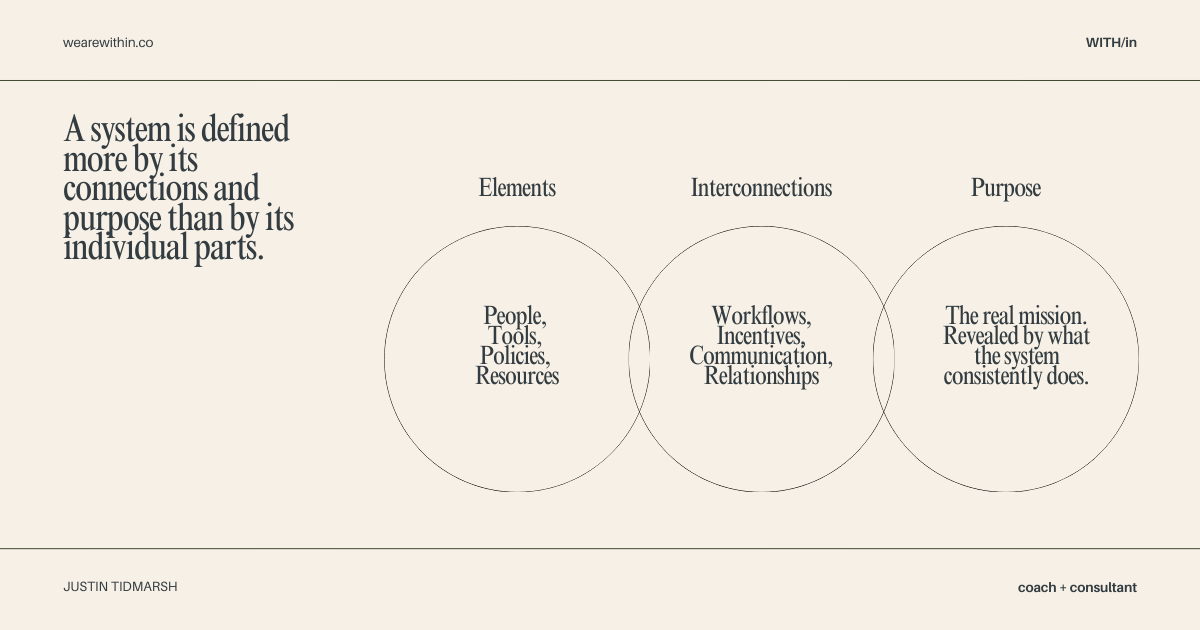
Systems are shaped by three components. Elements are the people, tools, policies, roles, and resources. Interconnections are the workflows, incentives, communication paths, and relationships that bind everything together. Purpose is the true mission, revealed not by slogans but by what the organization consistently does. Change the elements and little shifts. Change the interconnections or purpose and the entire system behaves differently.
Why Leaders Need a System
Most leaders solve problems where the symptoms show up. A missed deadline. A dropped handoff. A painful customer experience. But if a symptom keeps returning, the root cause is deeper. Systems Thinking helps leaders zoom out far enough to study patterns, understand the forces that shape them, and address the architecture rather than the noise. It also helps leaders see the ripple effects of decisions before they happen. In a complex system, every action influences something else. Without a systemic lens, even well-intended solutions backfire.
This shift is how organizations become resilient instead of brittle. It is also how leaders create the conditions for high performance without demanding burnout as the price of participation, reinforcing WITH/in’s belief that sustainable growth must support human wellbeing, not consume it.
Human Experience Meets System Architecture
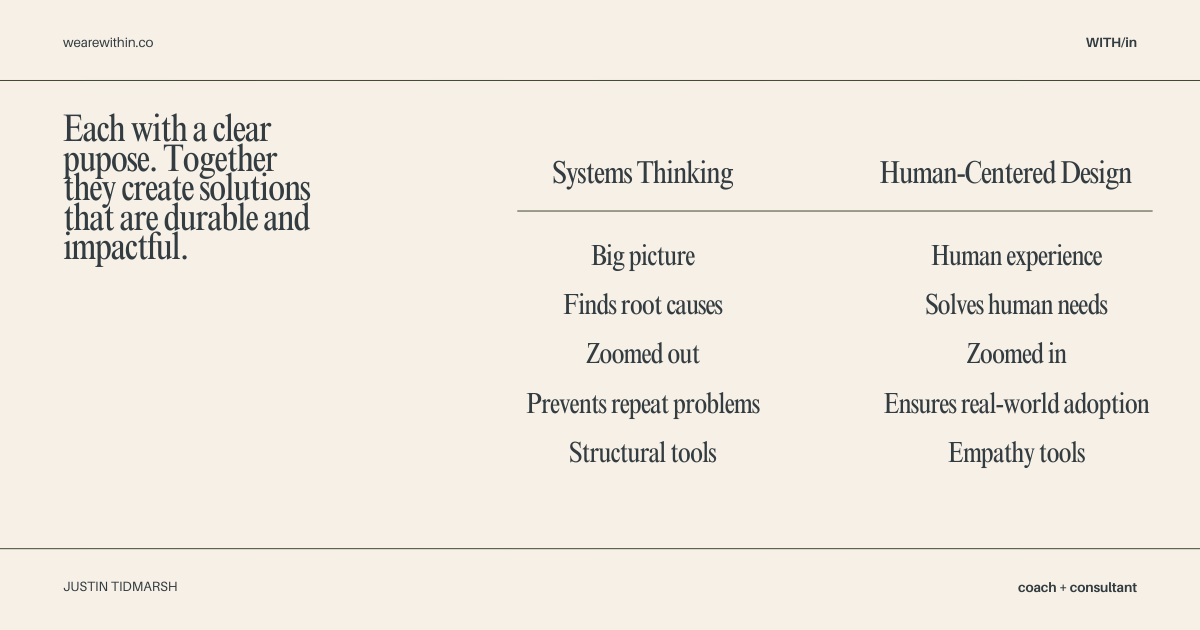
Systems Thinking provides the structural lens. Human-Centered Design provides the human lens. Alone, each is incomplete. Together, they form a Systemic Design approach that blends empathy with architecture so solutions work for people and also work for the intended impact.
To illustrate this, consider the holiday rush inside a major retail store. Systems Thinking looks at foot traffic, staffing patterns, inventory flow, and the structural decisions that determine whether chaos erupts or operations run smoothly. Human-Centered Design looks at what the shopper is experiencing in real time, noticing confusion points, emotional cues, stress triggers, and opportunities to reduce friction. Used together, leaders design environments that feel intentional instead of overwhelming. Structure supports humans. Humans inform structure. This balance is central to WITH/in’s mission of simplifying complexity and strengthening systems.
A Simple Comparison
| Topic | Systems Thinking | Human-Centered Design |
|---|---|---|
| Focus | The big picture and how things connect | People, their needs, and their real experiences |
| Main question | What is causing this pattern? | What does the human need right now? |
| Viewpoint | Zoomed out | Zoomed in |
| Strength | Prevents problems from repeating | Creates solutions people adopt |
| Risk alone | Too abstract, ignores humans | Fixes one area but breaks another |
| Tools | Maps, models, diagrams | Interviews, personas, prototypes |
| Best for | Complex, long-term problems | Product, service, and experience work |
| Together | Provide structure and long-term stability | Ensure solutions fit human behavior |
When Empathy Fixes the System
A powerful example comes from the University of Toronto’s Procurement Department. Researchers were avoiding the purchasing system. Compliance was low. Retention sat at 40%. Instead of buying new software or enforcing stricter policy, the team used a systemic approach grounded in empathy. They observed researchers, listened to their frustrations, and studied their workflow. The insight was clear. It was not a software issue. It was a friction issue. Researchers needed a process that supported their work, not one that slowed it down.
This reframed the system’s purpose from “enforcing rules” to “supporting research.” That shift changed workflows, communication, and outcomes. The results were significant. Savings of roughly $1.5 million in the first year. Compliance increasing from 40% to 99%. When human friction is removed, system performance accelerates. This is the essence of WITH/in’s vision: growth and wellbeing moving in the same direction.
Think about your own team’s system and approach this holiday. What areas could your systems be solidified? How inefficient (hopefully not!) is your weekly business review? How are insights feeding action you will take based on signals the team receives? Is the team empowered to act? Or do you make the call as the leader.
Tools Leaders Can Use
Three tools help leaders translate complexity into clarity. The Iceberg Model reveals how surface events sit on top of deeper patterns, structures, and mindsets. Personas and Scenarios humanize the system and expose the real context behind decisions. Causal Loop Diagrams map how variables influence each other and reveal hidden leverage points.
A simple way to audit your system is to pause and observe what the work is actually doing. Start by choosing one recurring pattern and jotting down when it shows up, who it affects, and what usually triggers it. Then trace one workflow from start to finish to see where it slows down or creates confusion. Finally, ask your team what part of the work feels harder than it should. These three quick scans surface the hidden structure shaping performance and point directly to where clarity can be strengthened.
Used consistently, these tools help organizations shift from reactive to intentional.
The WITH/in Point of View
At WITH/in, we help leaders and teams design systems that support how humans actually work. We apply a systemic, human-centered approach to everything we do. Our mission shapes our methodology. Our vision shapes the future we help clients build.
MISSION: Guide leaders to simplify complexity, strengthen systems, and drive sustainable growth.
VISION: A future where work is fun and sustained growth doesn’t come at the cost of human wellbeing.
We bring this to life through systemic diagnostics, leadership and team coaching, organizational and operating model design, experience and journey design, and workshops that build systemic literacy and cross-functional momentum. The goal is simple. Better systems. Better humans inside them. Better outcomes without burnout.
Bottom Lining It
Every leader operates within a system, whether they see it or not. When you understand the architecture behind behavior, you stop fighting fires and start reshaping the environment that produces them. You create clarity where there was noise. You design conditions that help humans thrive. You strengthen the foundations that make sustainable growth possible.
Systemic thinking is not a luxury. It is a leadership requirement in a world defined by constant change.
